The Office of Undergraduate Research holds undergraduate research festivals to recognize students' contributions to research, scholarly, and creative works at the University of Iowa.
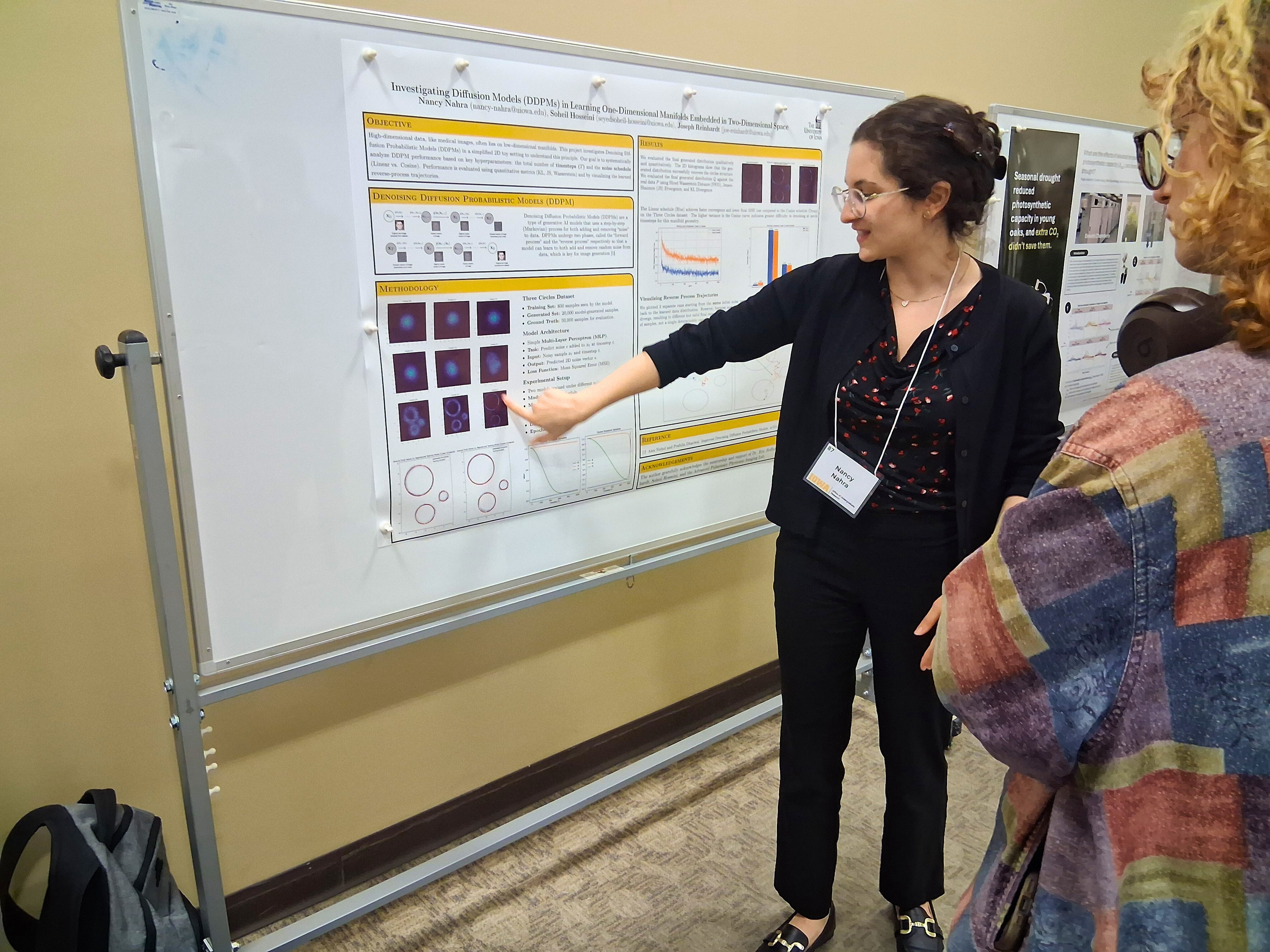
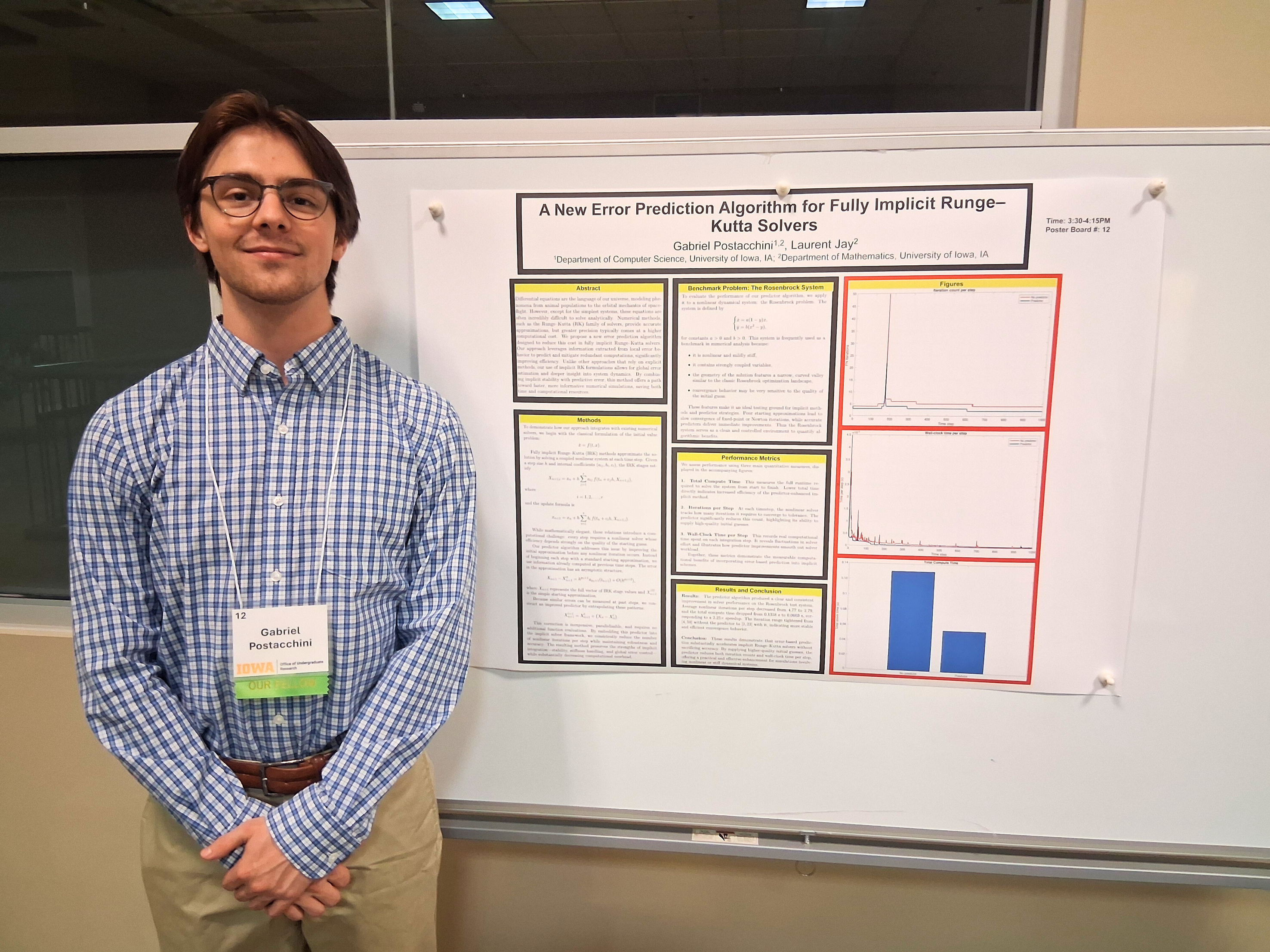
This year, 9 students from the Department of Computer Science participated in the Fall Undergraduate Research Festival (FURF). Students represented our Computer Science, Computer Science and Engineering, and Data Science programs with topics ranging from the merging of medical imaging with AI to Variational Autoencoders.
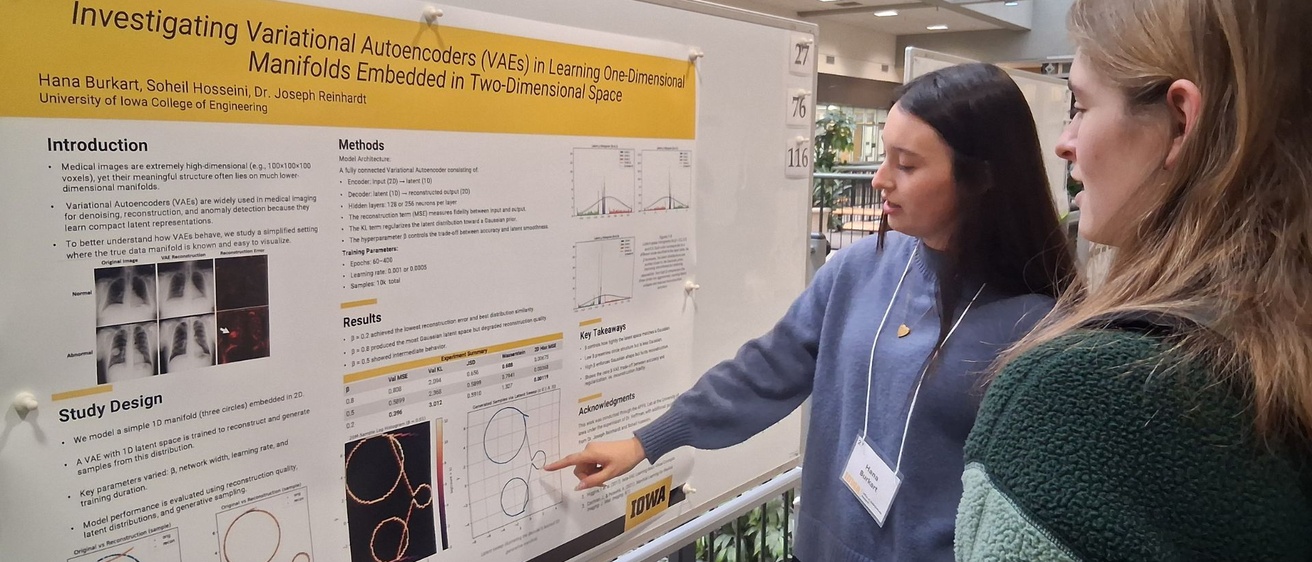
Hana Burkhart, a junior in the Computer Science and Engineering program, presented "Investigating Variational Autoencoders (VAEs) in Learning One-Dimensional Manifolds Embedded in Two-Dimensional Space." Her research focused on how Variational Autoencoders learn low-dimensional structure by training them on a simple dataset of three circles. She designed and ran the experiments, generated the evaluation figures, and analyzed how different β-values affect reconstruction and latent-space behavior.
"I loved how welcoming people were and how comfortable it became to explain my project as the conversations went on." - Hana Burkhart
What stood out to her most was the "range of creative, high-quality posters and the engaging conversations with people" because they helped her see her project from new perspectives. Everyone she interacted with came from different majors and backgrounds.
Her biggest advice for students interested in participating is to simplify your explanations. Burkhart said, "it pushed me to articulate my ideas clearly, which was really impactful for my own learning" because it made conversations easier for those without the same technical experience.
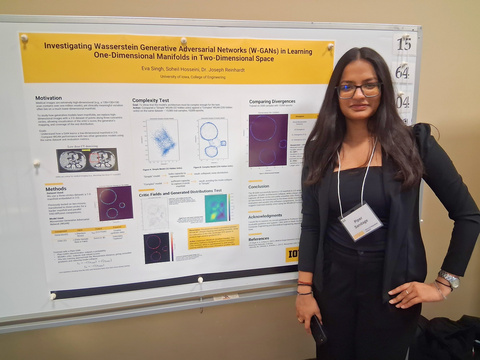
Eva Singh, a junior in the Computer Science and Engineering program, presented "Investigating Wasserstein Generative Adversarial Networks (W-GANs) in Learning 2D Probability Distributions" under the guidance and support of Dr. Soheil Hosseini, Professor Joseph Reinhardt and Dr. Eric Hoffman. Her research focused on studying how WGANs perform when learning structured data patterns. She used the Three Circles dataset and compared how different model capacities affected performance and mode collapse.
This was her first time presenting, so she was happy to say it was a positive experience. Singh also enjoyed how everyone she interacted with came from different fields, saying "they were very curious about my work at the intersection of medical imaging and AI, asked thoughtful questions, and made the experience especially memorable!"
Her advice for students interested is to come prepared: no stress, bring water, and talk to as many people as possible.
"I would absolutely recommend participating! FURF/SURF is a great platform to grow as a researcher and a presenter while sharing work you're proud of." - Eva Singh
Eric Newton, a senior in Computer Science, presented his work "The Iowa Vital Voices Project: Participatory action research to promote Latino civic engagement, political voice, and community health" with Iowa Vital Voices. It's a collaborative research initiative between the University of Iowa and the League of United Latin American Citizens (LULAC), the largest and oldest Hispanic civil rights organization in the US.
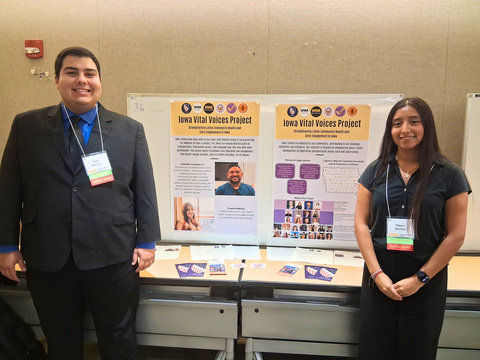
His research focuses on measuring Latino civic engagement and public health across Iowa through surveys at community festivals and recorded interviews that will eventually become part of the library's oral history archive. As a researcher, he travels to events like the Latino Festival in Iowa City to invite community participation, transcribes and translates interviews between English and Spanish, and works to combat biased narratives about Iowa's Hispanic community.
"I'm grateful for the many visitors who came to the Iowa Vital Voices poster and had great questions." - Eric Newton
What stood out to him most was the opportunity to engage with diverse audiences about this important community-centered work. Previously serving as president of U Iowa's LULAC Council, where he organized large cultural events like Cinco de Mayo and Dia de los Muertos, he brought valuable experience in bridging academic research with community engagement.
His biggest advice for students interested in participating is to embrace the challenge. Newton emphasized that showcases like FURF help students develop their "ability to take concepts about their research and distill in a way every visitor can understand."
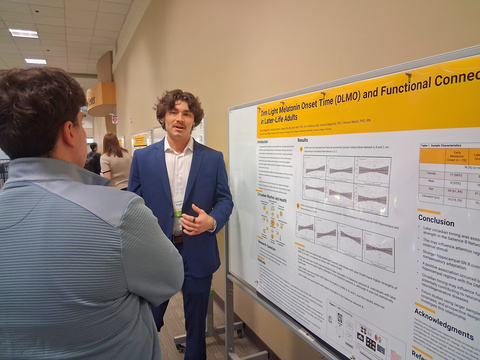
Connor Baggot, a senior in Computer Science on the pre-medicine path, presented "Dim Light Melatonin Onset and Functional Connectivity in Later Life Adults." It was research examining how circadian rhythms—measured by Dim Light Melatonin Onset (DLMO)—relate to the strength of neuronal connections in brain regions tied to attention and memory. Using resting-state fMRI, the study explored how early vs. late circadian timing was associated with functional connectivity in the Default Mode Network, Salience Network, and Hippocampus in older adults. These regions were chosen to better understand whether disruptions in circadian rhythm may be linked to neuronal changes that contribute to cognitive decline in individuals at risk for Alzheimer’s disease and related dementias.
They processed the raw z-scores for each participant, analyzing how DLMO aligned with patterns of functional connectivity—an ideal intersection of their interests in computation and medicine.
What stood out most was the moment their principal investigator stopped by to listen to the presentation and express how proud she was of the work accomplished over the past several months. They also loved being able to explain the project clearly to a wide range of people—from friends without technical backgrounds to a radiologist who stopped by and deeply engaged with the research.
One of the most meaningful parts of presenting was hearing friends say how understandable the project felt. “I loved being able to present my research in an understandable way to a large variation of people,” they reflected.
Their biggest advice for future participants: absolutely go for it. “I would 10000% recommend anyone to participate in FURF—it’s an amazing experience where you can show off what you’ve been working on and see a group of similar students doing the same.”
“Nothing is a greater feeling than hearing your closest friends express gratitude and pride for all the work you have put into this.” - Connor Baggot