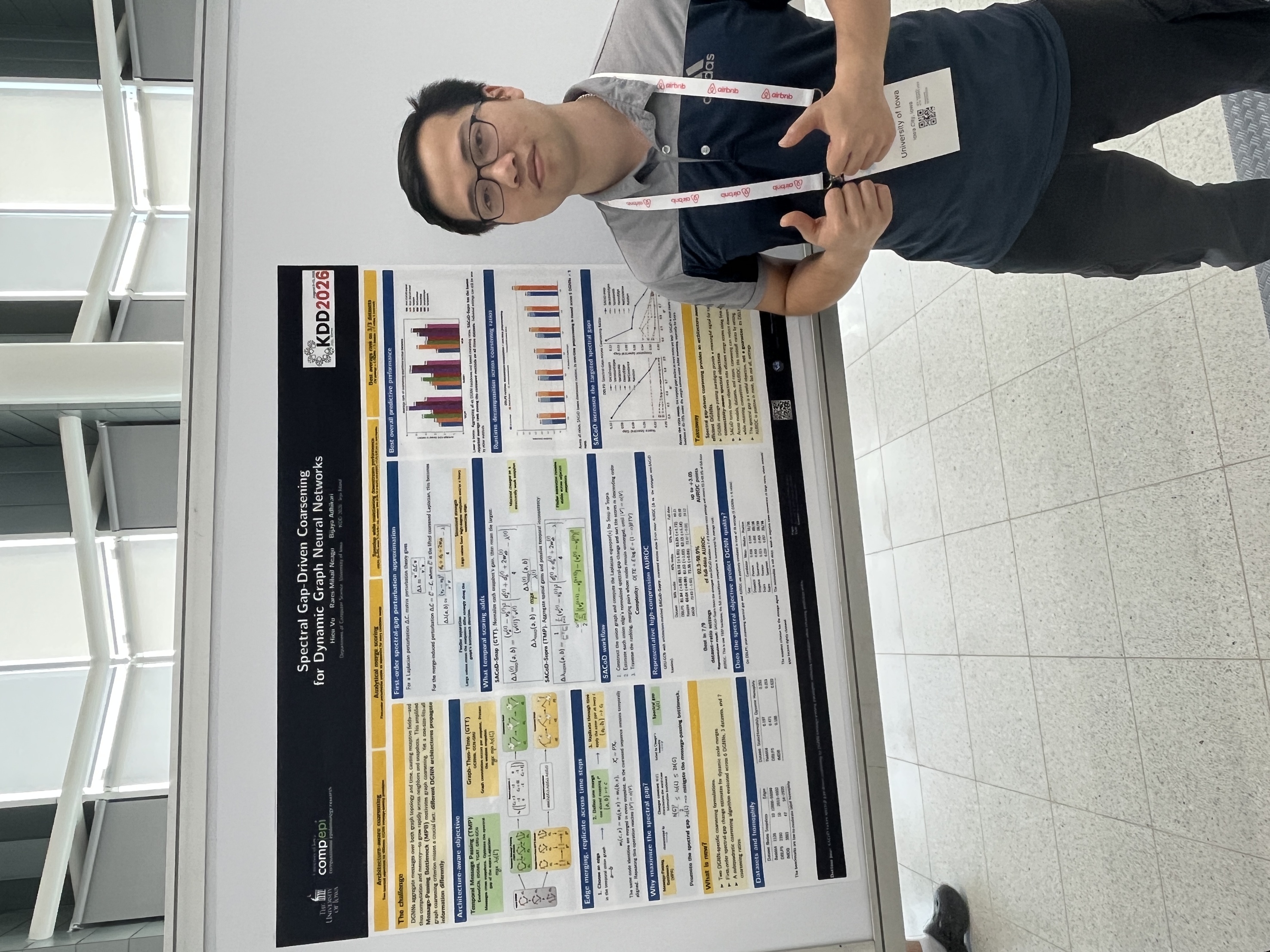
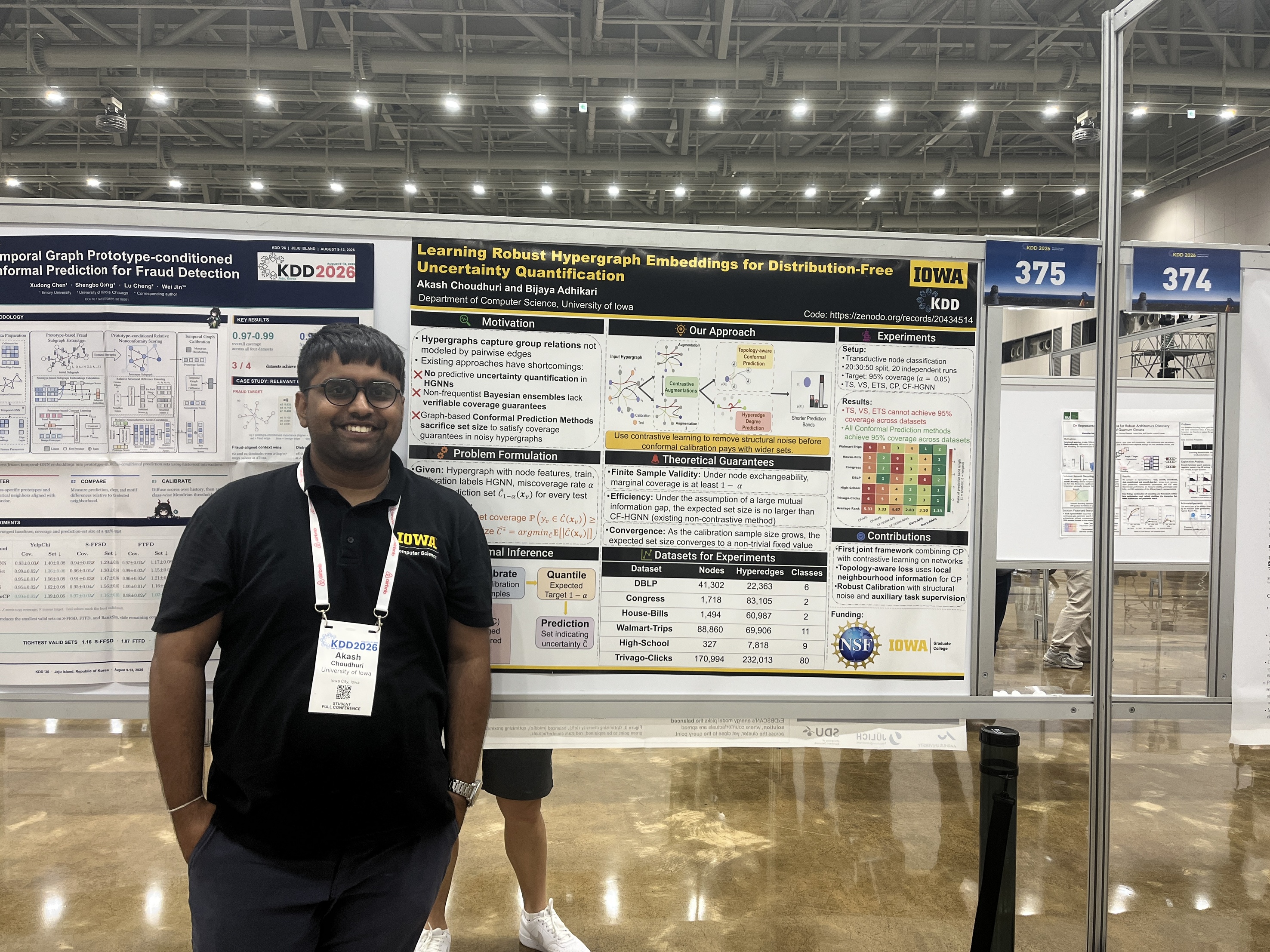
This August, two University of Iowa PhD students in computer science, Hieu Vu and Akash Choudhuri, presented their research at KDD 2026, held on Jeju Island in South Korea. (KDD stands for Knowledge, Discovery, and Data Mining.)
On their return, both Hieu and Akash listed a wealth of networking opportunities they enjoyed at the conference. In addition to these, Akash and Hieu highlight the best parts of their trip below:
What were the highlights of the KDD 2026 conference for you?
Akash:
“One of the most memorable aspects was realizing how connected I was to many attendees through my academic lineage. I interacted with Dr. Rodriguez from the University of Michigan, who had been a fellow PhD student with my advisor under the same advisor. During a Pinterest networking event, I also met Dr. Chen, and we later discovered that he had completed his PhD alongside my advisor. Similarly, I spoke with Professor Papalexakis, who completed his PhD under my advisor’s advisor. These interactions helped me better understand the academic community that has shaped my own research.
“Another important part of KDD was meeting PhD students working on research problems similar to ours. Through my advisor’s initiative, we connected with the students of several of his colleagues. We discussed the overlap among our research areas, compared the problems we were currently studying, and considered open questions that we might explore in the future. These conversations were particularly useful because they went beyond simply presenting completed work; they gave us an opportunity to think together about possible new research directions and collaborations.
“Attending specialized sessions such as Health Day allowed me to hear experienced researchers discuss current challenges in healthcare and biomedical data science, as well as the methods they are developing to address them. The keynote on the final day was also especially relevant to my work. It discussed the current state of biomedical graph-based research and examined why existing foundation models do not always perform well for these problems. This helped me think more carefully about both the potential and the current limitations of foundation models in biomedical applications. Overall, KDD 2026 helped me understand the current state of research in my field from several perspectives.”
Hieu:
“One of the main highlights for me was Health Day panel, were especially relevant to my interests in healthcare applications. I was particularly interested in the talk by Professor Witschey from the University of Pennsylvania, which provided several insights into the process of deploying AI-powered systems in real clinical settings. One important takeaway was that technical model performance is only one component of a deployable system. He emphasized the importance of inspectable answers, comprehensive and meaningful evaluation suites, and stakeholder-driven ethical agents for determining appropriate clinical actions. These considerations are particularly relevant to my own research goal of eventually developing systems that can support clinicians and facilitate data-driven clinical research.
“I also found the PhD Consortium particularly valuable. As I am now working toward shaping my individual research projects into a coherent dissertation, it was helpful to see how other PhD students frame their research questions, connect multiple projects under a broader thesis, and communicate the overall contribution of their PhD work. This gave me useful perspectives as I think about how to structure and present my own dissertation research.”
What advice would you give for someone presenting at the next KDD conference?
Akash:
“My first piece of advice would be to approach the presentation as a conversation and remain open to the different kinds of feedback you may receive. You should be able to give a short, accessible explanation of the problem and its broader scientific impact, followed by a more detailed description of the method for people familiar with the area. Preparing only for highly technical questions may make it difficult to engage attendees outside your immediate research community.
“My second piece of advice would be to use generative AI carefully when preparing posters and talks. I saw several posters that appeared heavily AI-generated and presentations that relied on generic, scripted language. After encountering many of them, I found it difficult to remain engaged because the posters and talks often felt interchangeable and did not clearly reflect the researcher’s own perspective. AI can be useful for brainstorming, proofreading, or improving an early draft, but it should not replace the presenter’s judgment.”
Hieu:
“KDD brings together people working in very different areas, so I think it is important to first give the audience an accessible explanation of the problem and why it matters before going deeply into technical details…With limited presentation time, I would recommend selecting the few contributions that are most meaningful and building the presentation around them.
“For a poster presentation, I would strongly recommend preparing a very short version of your research story. Many people initially spend less than 30 seconds looking at a poster before deciding whether to stay, so being able to explain the motivation, main idea, and significance of the work in roughly 30 seconds is extremely useful. If they are interested, you can then move into a deeper discussion.”
What was it like visiting South Korea?
Akash:
“A major reason that the trip went so smoothly was Jin, another PhD student in our department, who lives in Seoul. He spent the first two days showing us around and introducing us to the culture. He explained how to handle common situations, how to interact with people, and which places were worth visiting. That early guidance helped us become more confident when we later traveled to Jeju, where the environment and pace were different from Seoul.
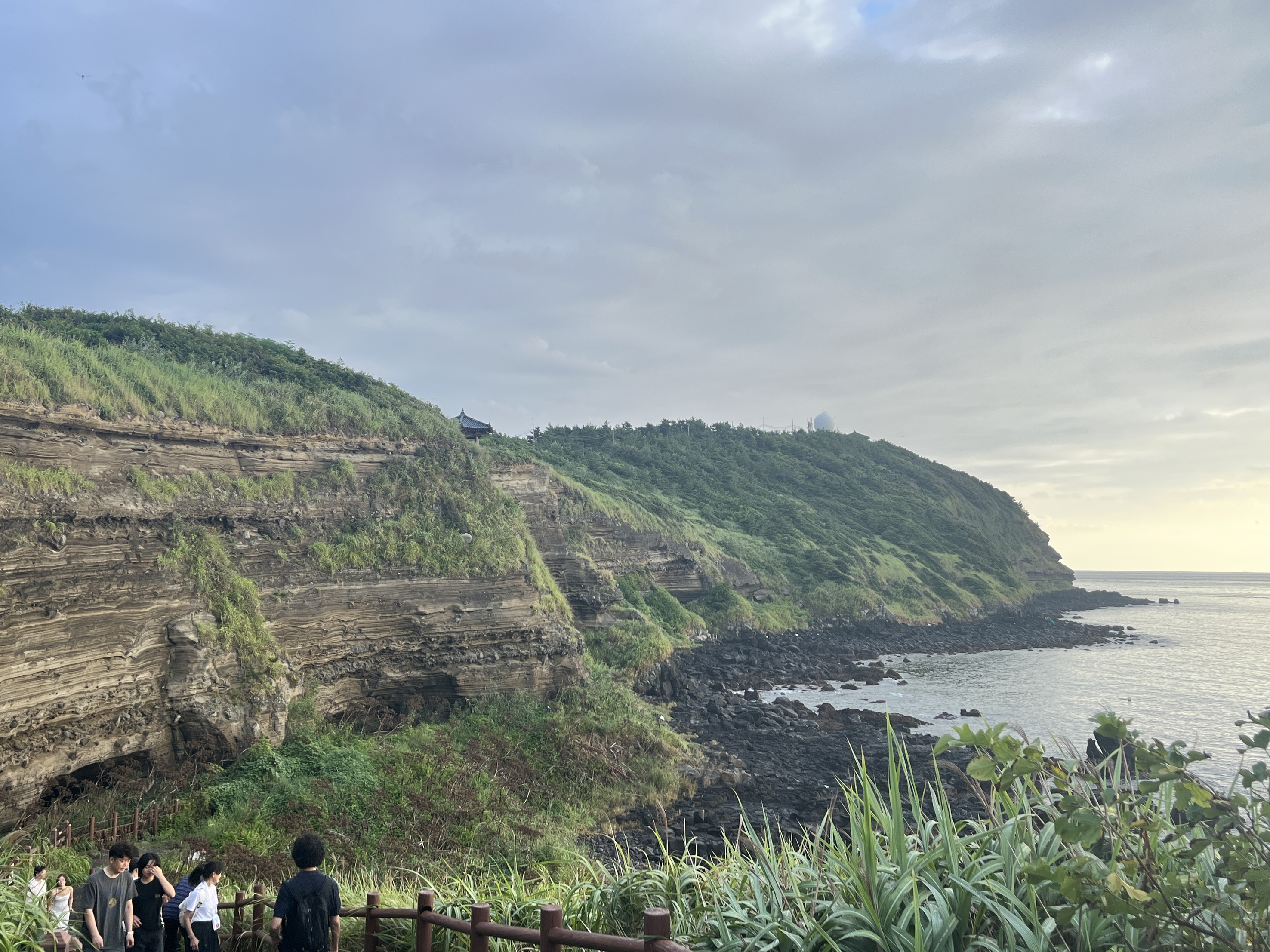
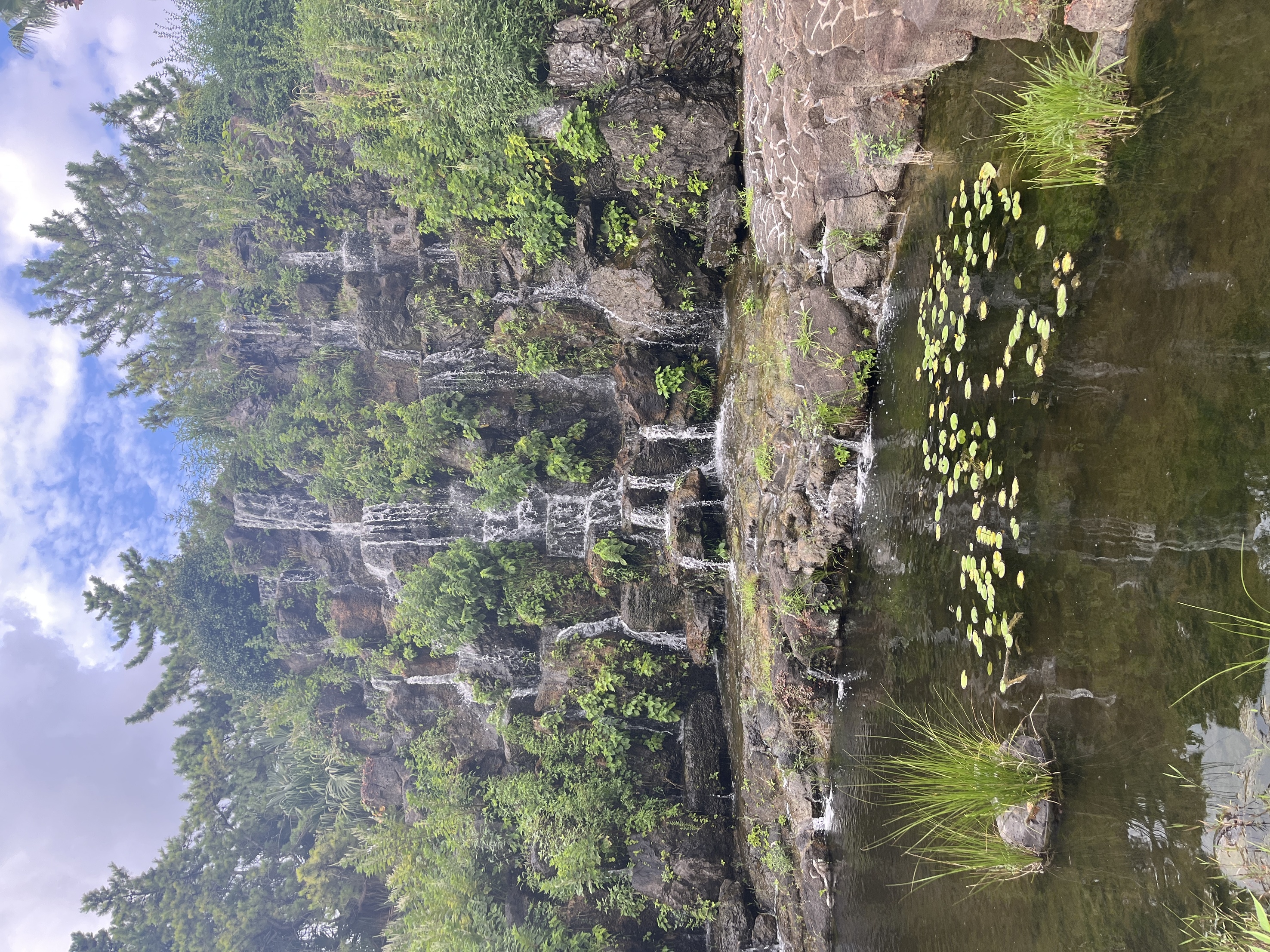
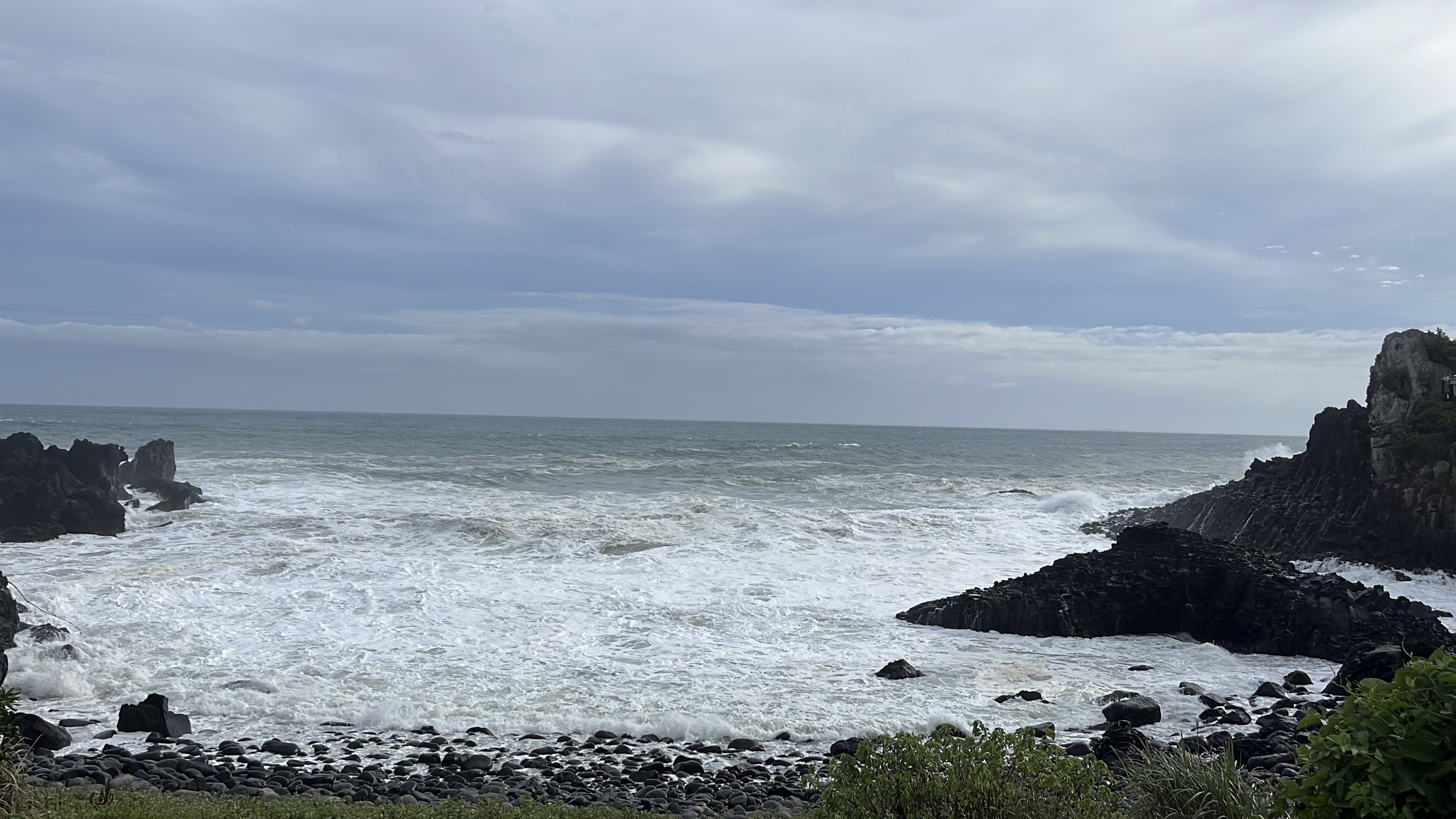
“Jeju was one of the most memorable parts of the trip. The island was exceptionally clean and green, and I particularly enjoyed the clear ocean and the sunsets along the coast.
“Visiting South Korea was one of my first experiences traveling in East Asia, and it was quite different from both the South Asian culture in which I grew up and the American culture I have experienced over the past few years.
“One of my strongest impressions was how orderly and punctual daily life seemed. Even in a large and busy city such as Seoul, people appeared attentive to schedules, public transportation, and the expectations of shared spaces. I was also interested in how traditional and modern ways of life existed together. We saw traditional food stalls, markets, and customs alongside a highly modern and internationally influenced urban culture. Neither seemed entirely separate from the other, and observing how they fit together was one of the most interesting parts of the visit.”
Heiu:
“My trip to South Korea became more eventful than I expected before I even arrived. My original flight to Jeju was cancelled because of a typhoon, so I had to find and book an alternative itinerary that same night.
“One of my favorite parts of the trip was joining an excursion organized through the conference. Our tour guide was extremely enthusiastic and introduced us to more of the history, culture, and natural landscape of Jeju. We visited the Hallim area, including the lava caves, and later Suwolbong. The excursion ended with a beautiful sunset along the coast, which was a memorable way to finish the trip after several intensive conference days.”
Any advice for those visiting Korea for the first time in the future?
Akash:
“Food was sometimes challenging for me because I do not eat beef or pork. Since both are common ingredients, particularly outside major tourist areas, finding suitable protein options and confirming ingredients required additional effort. Also, if you have any meat restrictions, make sure you ask about the broths before consuming anything soupy.
Hieu:
“I would recommend being prepared for the language barrier, particularly outside the most international areas. Having a translation app such as Papago on your phone can make everyday interactions much easier.
“Transportation is also worth planning in advance. Since many drivers may not speak English, it is helpful to have your exact destination or drop-off point ready to show them. I would also recommend having local navigation and transportation apps installed before traveling. Naver Map is a good option for checking bus schedules, routes, and more accurate travel-time and distance estimates, since Google Maps can be less reliable in Korea.”