
Department of Computer Science faculty, Dr. Cesare Tinelli, recently received the honor of Erich Funke Professor in the College of Liberal Arts and Sciences at the University of Iowa.
Professor Tinelli's research interests include automated reasoning, formal methods, software verification, foundations of programming languages, and application of logic in computer science. He is the Co-Director of the Computational Logic Center, as well as the recipient of an NSF Career Award.
His research has been funded both by governmental agencies (AFOSR, AFRL, DARPA, NASA, and NSF) and corporations (Intel, Rockwell Collins, and United Technologies). His work has appeared in more than 60 refereed publications, including articles in such journals as Artificial Intelligence, Information and Computation, Formal Methods in System Design, the Journal of the ACM, Logical Methods in Computer Science, and Theoretical Computer Science.
"This is a well-deserved honor and recognizes
Cesare's contributions to our discipline."
- Alberto Segre, Chair, Department of Computer Science
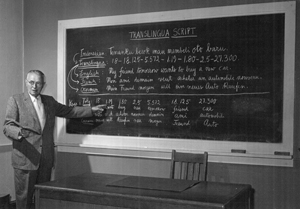
Erich Funke was born December 11, 1891, in Rogaetz, Elbe, Germany. He graduated from Realgymnasium (high school with scientific emphasis) in 1912, and attended college at Leipzig, Munich, and Zurich, before taking his Ph.D. at the University of Halle in Germany, 1921. Funke married Lydia Gunzenhauser, and the couple had one son, Thomas, born in 1928. Dr. Funke joined the staff at the University of Iowa as assistant professor of German in 1931 and was made full professor and head in 1937.
In 1953 Dr. Funke began developing the Translingua Script -- a system of numbers he devised for communication which would replace words that require translation between languages. Funke received international recognition for the Translingua Script in 1957. Erich Funke retired in 1960 and died November 5, 1974.
The Department of Computer Science at the University of Iowa is proud to have innovators like Dr. Cesare Tinelli, in the tradition of Erich Funke, who have earned international respect among fellow academic and research leaders in computer science.